


Patricia, Beatriz, and Constanza Morén are three sisters living in Spain. They joined People First Radio to share memories of their father, who died last year.
“He was the best father a daughter could have,” Constanza said.
“My father worked as an industrial engineer in the civil service in Spain and made a very good and tasty potato cake,” she said.
“I also remember that he held my hand every day as he walked me to school, taught me and my two sisters to ride bicycles and also to drive a car in our hometown of Tarragona.”
When the three sisters were children, their father developed schizophrenia.
“As the eldest of the sisters, I remember clearly the moment. I was 13, when my father was admitted to a psychiatric hospital,” said Patricia.
“We were some days out of the school, due to this difficult situation in my family, and when I went back, a girl asked me, why was your father at the hospital? Why didn’t you come to the school? It was terrible, a shock for me, this question, I said, ‘I’d rather say nothing’,” she said.
“It was the first time I felt the stigma.”
Constanza, the youngest of the three sisters, cannot remember a time before her father’s illness.
“For me, it was normal to walk next to a father who sometimes shouted at people or covered one ear to avoid hearing other people’s conversations, but I realized that for the other people, this did not seem normal,” she said. “Sometimes I was scared or other times I felt embarrassed, but…[by] my 30s, my 40s, I have really changed those feelings for the feeling of pride of walking next to my father.”
Beatriz said that despite her father’s illness, he was a fighter.
“He had a good job during all his life. He had autonomy. He had a house,” said Beatriz. “I think that he was very clever and he was very smart.”
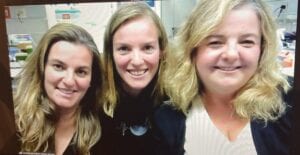
Beatriz, Constanza, and Patricia Morén.
Constanza said she never felt like her father’s illness had shaped her career, until she saw a job posting in 2020 looking for a coordinator to work in a lab researching schizophrenia.
She got the job, and now works under Dr. Eduard Parellada at the Institut d’Investigacions Biomèdiques August Pi Sunyer in Barcelona.
“I’m really happy here. I feel I can help for increasing research in this disease that is really kind of abandoned when talking about investment, and I can help in this for my father, for my family, but for so many other families who suffer,” she said.
“Now that my father is no longer physically here, I see that the three of us, we can dedicate all the efforts, all the energy that we used to dedicate him…now we can dedicate that energy to other people who, maybe they are suffering alone or in silence, as we did,” she said.
“We didn’t have extra time or extra energy to deal with other things…but now we have, and we can maybe accompany those people that are like we were before.”
Patricia works as a journalist, and often focuses on mental health..
” I really try to write my news with love, choosing each word carefully. And this is very difficult to do if you are not next to the disease,” she said
She says she feels it’s important that schizophrenia receives coverage in the media.
“When journalists talk about schizophrenia, well, they don’t talk,” she said. “Quite often they talk about depression, eating disorders, bullying, burnout, but schizophrenia is not there, so we have to put the schizophrenia in the media”
“it’s uncomfortable to talk about schizophrenia. It’s a very long word to put in the headlines, but we have to find a way,”
Beatriz works as a veterinarian, she says she hopes by speaking about her family’s experience together with her sisters, they can help others who might be going through something similar.
Listen to the full interview using the audio player at the top of the page.
 Apple Podcasts
 Spotify
 YouTube