
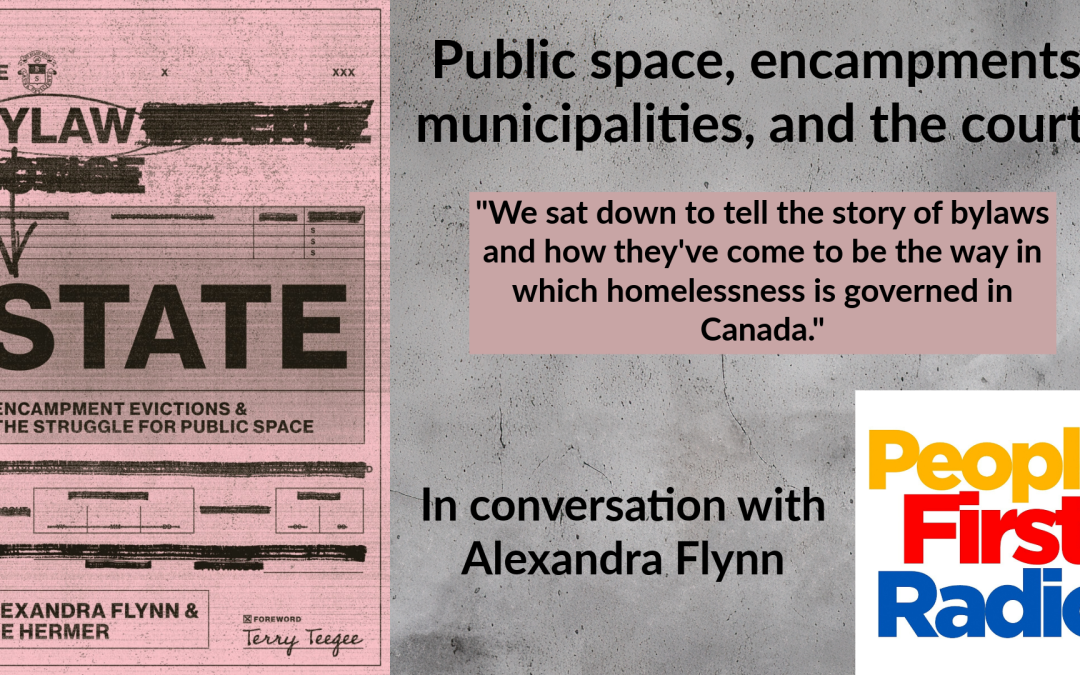


A UBC law prof argues that homelessness in Canada is governed by a patchwork of municipal bylaws.
Alexandra Flynn is co-author of The Bylaw State, a book that explores municipal government responses to homeless encampments from a legal perspective.
Flynn says that the idea for the book came when she and coauthor Joe Hermer were working on a project around encampments with the Federal Housing Advocate.
“We couldn’t really find anything about the legal aspect of bylaws and what it meant for unhoused people,” said Flynn. “And so we sat down to tell the story of bylaws and how they’ve come to be the way in which homelessness is governed in Canada.”
Flynn says Canada’s existing legal framework on housing creates a vaccuum.
“In Canada, we don’t have a very good housing framework, like a legal framework for who’s responsible for housing,” she said.
“Most other issues, there’s a government that’s listed in the constitution, and that’s the government that you would turn to to be accountable. And so housing is one of those areas where nobody really wants to be accountable, because it costs money, and it’s complicated.”
Flynn says that ultimately if people become homeless and are forced into public space, it becomes a de facto municipal issue.
“Municipalities oversee public space. And so, you know, parks are not meant to be slept in, and there’s bylaws that are written that say that you can’t be here overnight, or you can’t pitch a tent, you can’t use this space in a certain way, and those are the bylaws that end up being used to remove people from those public spaces.”
She says the courts end up being an important player in the situation as well.
“Municipalities will basically look for an injunction to remove people from encampments. And so they go to court, and they argue why this is necessary. Sometimes they don’t even go to court, but if they do, they argue why it’s necessary,” she said.
“And increasingly, homeless people with their lawyers and advocates will argue that the use of that injunction or the attempt that the city’s trying to do…violates the Charter of Rights and Freedoms, and specifically Section 7, the right to life, liberty, and security of the person.”
Certain cases establish limits on what municipalities are allowed to do, such as the 2008 case Victoria v. Adams, which was substantively upheld on appeal the following year.
“ That’s the case that set this framework of municipalities cannot remove people at night if there’s not enough accessible shelter space,” said Flynn.
She says that because courts are deciding on the facts of individual cases, we don’t have clear and specific rules for all municipalities about what they are supposed to do to address homelessness.
Flynn says the framework of municipal bylaws can be de-humanizing for people experiencing homelessness.
“The biggest thing that I heard from unhoused people myself was, ‘treat us like human beings,'” she said.
“I think doing that changes everything. Like, bylaws are meant to regulate spaces. They regulate things like what is garbage, you know? What is a blight that shouldn’t be there in public space? And homeless people are treated in the same category.”
Flynn argues that all levels of government need to address the causes and consequences of homelessness.
“I would say we have to confront the fact in Canada that we have created this situation of a housing and homelessness humanitarian crisis. We have done this through our governments, through our decisions around how much we tax, what our priorities are, and, and we have to make different decisions around it.”
“What’s my perfect alternative view? It’s to recognize that this is a terrible crisis, that the legal framework that we have right now doesn’t seem designed to fix it, but increasingly courts are going to say, ‘this is the government’s job to do it, and we’re going to force them to.'”
 Apple Podcasts
 Spotify
 YouTube