
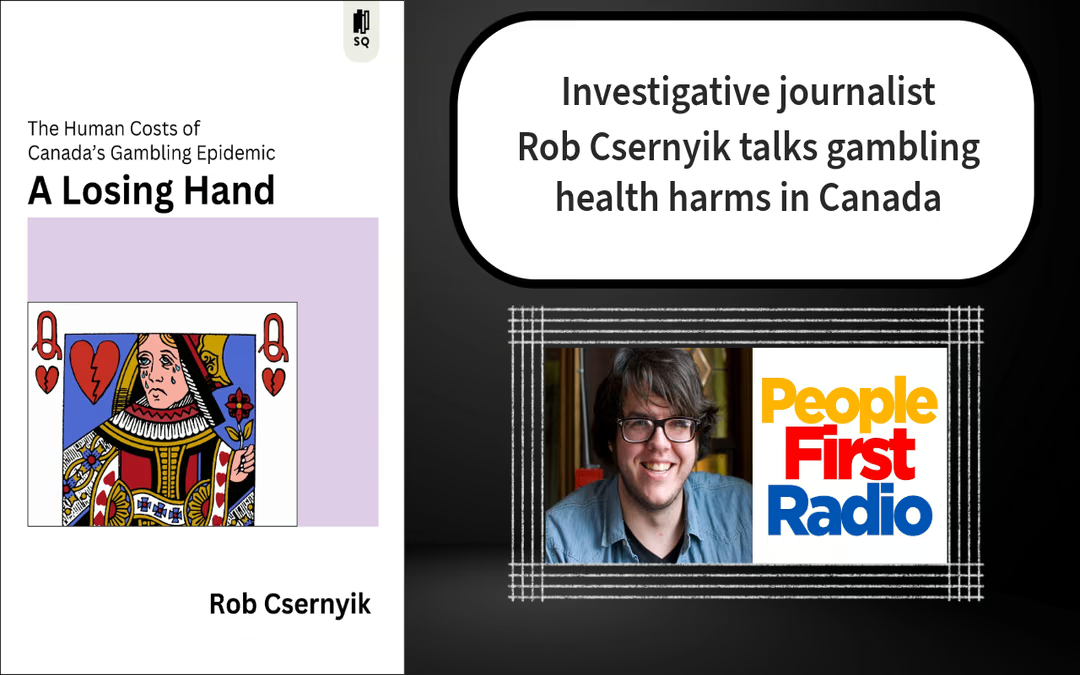


Rob Csernyik is an investigative journalist who lives in Atlantic Canada and covers the gambling beat. He’s the author of A Losing Hand, a new book that takes a look at the issue of gambling related suicides in Canada.
“ We have a very robust industry of legalized gambling, and yet we also have…a big preoccupation in this country when it comes to mental health and suicide prevention,” he said.
Csernyik says in the early days of legalized gambling in Canada, there were a number of stories in the media about gambling related suicides.
“ I would say, kind of early to mid two thousands, they mostly just petered out of the headlines. And it was obvious that this was not a topic that had disappeared,” he said.
In 2003, chief coroners across the country agreed to pay more attention to tracking gambling related suicides. Csernyik set out to explore the results of that decision.
“ I figured there would be a lot of very clear data, you know, twenty-plus years after the fact,” he said. “But in the end, the amount of data provided was quite minimal…and the numbers, quite frankly, weren’t large enough to really tell us a data story like that.”
“Instead, the bigger story ended up being, well, why has this fallen by the wayside? And why now, at a time when we should be able to look at the past and figure out how the new expansion of gambling might affect this issue, why is it that we can’t do that because we simply don’t have enough concrete info here in Canada?”
Csernyik says that record keeping in Canada is not adequate on the issue of gambling related suicides.
“ I would say quite confidently, we can say that as a nation, we are not keeping track of these deaths, and we do not understand the full scope of that human cost of the gambling industry.”
He says that as a society, there hasn’t been a reckoning on the issue of what we want government run or regulated gambling operations to be.
“One of the main questions that I think we haven’t grappled with is more or less what is a lottery corporation or what is an iGaming corporation?” He said. “What I mean when I ask this is what is the intent?”
He cites the example of cannabis in his home province of New Brunswick as providing a counterexample.
“There is now a provincially owned cannabis store, but they tend to be pretty discreet locations. And, they’re only open set hours, and there’s a lot of little protocols that they follow…it’s just sort of designed that way because they don’t want people to say overconsume. They don’t want a certain reputation around the industry. And I think that’s very different than what we see in the gambling industry because we haven’t really asked those questions.”
“I think a big part of it is would we rather see a gambling industry be, say run for the sake of having a legalized gambling option so that people who want to play have an option, it may not be a fancy option like in Las Vegas, but something serviceable where if they want to spend a little bit of money and have a bit of entertainment, and they’ll know that they’ll get that money back and that they can sort of feel, I guess, a bit safer doing it, than using an unregulated version.
But that is a very different kind of model than, say, you know, the heavily advertised iGaming industry where you have all of these big industry proponents, these big American companies, getting licenses for websites and everything. And I think that is a distinction that we probably should have thought about a lot more.”
Listen to the full interview above.
Resources
Gambling Support BC: https://www.gamblingsupportbc.ca/
World Health Organization gambling fact sheet: https://www.who.int/news-room/fact-sheets/detail/gambling
 Apple Podcasts
 Spotify
 YouTube