
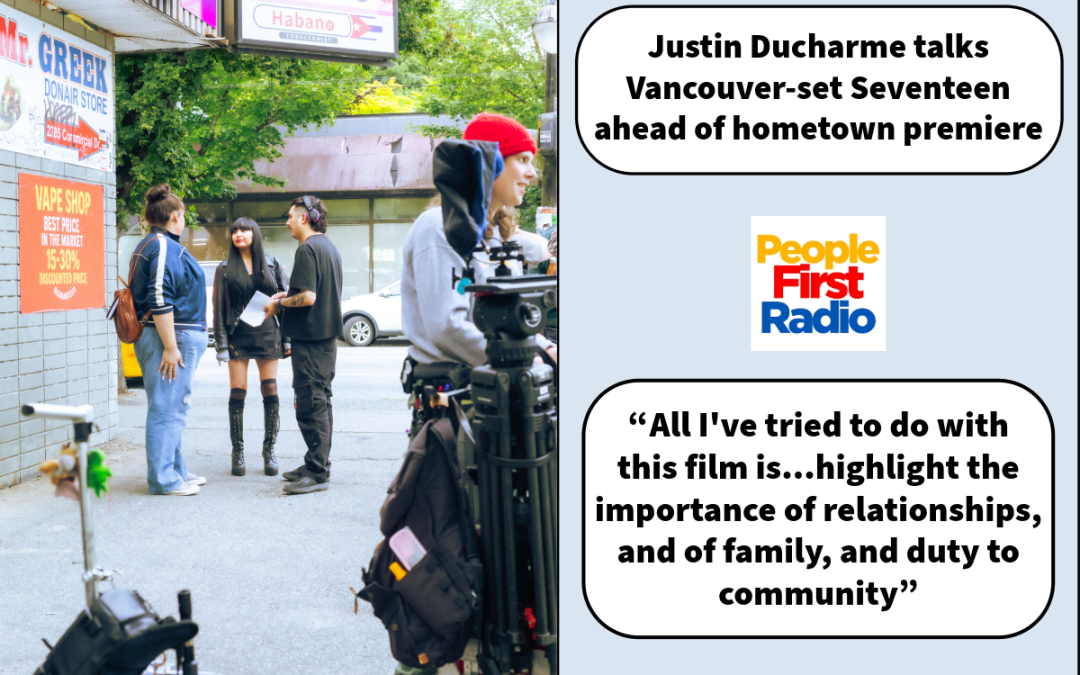


Justin Ducharme says his debut feature film Seventeen was inspired by his own experiences living in Vancouver.
“ Something that I’ve always been really interested in as a filmmaker, and a lot of my work explores is this contemporary urban Indigenous queer experience,” he said.
Seventeen is set in and around Vancouver, and follows 3 Indigenous sex workers over the course of a hectic day that sees them caught up in tasks like trying to come up with the money to secure housing, or trying to track down a missing passport on a tight timeline.
Ducharme, who first disclosed publicly his experience of sex work eight years ago through his artistic work, says Seventeen isn’t directly portraying his exact lived experience.
“Something that I’ve tried to do is take maybe like visual cues or aspects of scenarios that for me feel signifying of my time as a sex worker, as, someone trying to find housing, as someone grieving a parent, any of the sort of things that my characters go through in the film,” he said.
Ducharme says he never wanted the film to be focused on the traumatic aspects of what the characters are going through.
“I really wanted the focus of the film to be on the lesser shown moments of those days, and try to tell a story that felt like it sort of played with expectation as far as what people might expect when they see a narrative about, whether that be sex workers or queer indigenous people, the two-spirit community,” he said.
“It feels sort of like an ode to this tenderness that I feel the community has deserved, and specifically, I think also Indigenous women in cinema.”
The film is playing at next month’s Vancouver International Film Festival, coming to screens in the same city it was shot and set in.
Ducharme says there was a thoughtful approach to how the production was taking up public space while they were filming.
“ I really didn’t want to shut any streets down or, you know, be this massive sort of like displacer of community when I was telling a story about these streets and these people.”
Ducharme says he was coming to the film with an eye towards representing sex work from an Indigenous perspective, which he says is still considered quite taboo and wrapped in negative connotations.
“I understand why. There is a lot of violence attached to this. And I think with this, you know, I chose to focus the narrative around representing us as people with chosen family, with real family, with duty to community, things that I think all indigenous people understand and can relate to.”
While the film is informed by his lived experience, and close consultation with members of the queer Indigenous sex work community in Vancouver, Ducharme is aware that it won’t be a monolith that speaks to everyone’s experience.
“We premiered the film last week in Toronto and, you know, I’ve seen some reactions to it and one of the things that I saw was someone felt that it didn’t feel authentic to them. And, you know, they’re also not a queer Indigenous person doing sex work in Vancouver. But I think that that type of reaction to this work actually, that makes sense to me in that I enjoy that because I think it proves that we are all different and that the things that bring us to this work or the circumstance that leads us here or whatever it may be, the choices, it’s all different,” he said.
“There are gonna be some people, there might even be some sex workers in Vancouver who watch this and don’t feel that [it is authentic to their experience]. And I think that that is reflective of just how diverse and…common it is…these experiences are not all one.”
Ducharme says he hopes audiences take away the importance of family and relationships for people in situations like the characters in the film. He says while making the film, he was conscious of the relationship between how people are perceived and their ability to move through the world.
“When I came out as a sex worker, I think there was maybe a protection that I felt…or, like a relief from being public about things and making creative work from a perspective of that. But I also think that I learned very quickly that perception is huge, in how people choose to sort of speak about you, or write about your work,” he said.
“All I’ve tried to do with this film, is sort of highlight the importance of relationships and of family and duty to community and these things that I think feel really prevalent to Indigenous communities in Canada, and around the world.”
Photo credit: Celina Koops
 Apple Podcasts
 Spotify
 YouTube