
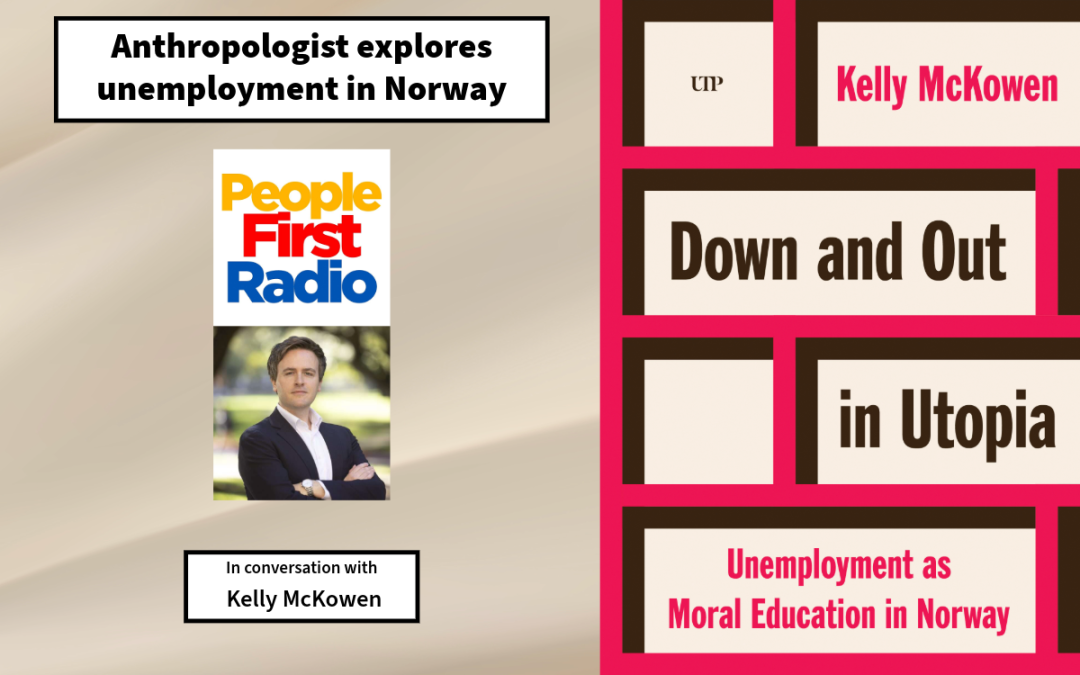


Kelly McKowen spent years talking with people who were unemployed in Norway. In his book Down and Out in Utopia, the assistant professor of Anthropology at the College of William And Mary provides a look at what can happen if you lose your job in one of the world’s wealthiest and most egalitarian countries.
McKowen spoke with People First Radio host Joe Pugh about the book. He explains that people seeking unemployment support in Norway rely on the The Norwegian Labour and Welfare Service, or Nav for short. The cradle to grave welfare agency also connects Norwegians with a number of other social services.
McKowen has been going to Norway for around 15 years. He explains the thinking behind his look at the issue of unemployment in the country.
“ The first thing that I wanted to look at was what happens when a person loses their job in a comprehensive social democratic welfare system, and second, what are the implications of that for how they think about government and taxes.” He says.
“ What I found was that the system’s remarkably, we’ll say integrative, that it really gets everyone on the same page, or almost everyone on the same page with respect to, the kind of moral significance of both work and minimizing one’s dependency on the welfare system.”
McKowen says that the system entitles people to a great deal of support when times are tough.
“I think a lot of people would assume that that means, like, aren’t people just living on the dole? Aren’t they just availing themselves of all of this support to avoid work?” He asks.
“There’s a little bit of that, but not a lot. Labour market participation rates are comparatively very high.”
“How do we make sense of a system that’s seemingly, and here’s that word again, so generous, and yet it’s not minimizing or destroying the work ethic? The short answer is what I found is that I think generosity and obligation are two sides of the same coin.”
McKowen explains that he found the system engendered a belief in people that they should be working and paying taxes in the middle third of their lives.
“It’s no secret that Norway is at the top of the world when it comes to quality of life. And so I think people, they become acutely aware of the fact that they have a role to play in protecting that.”
He says that people’s expectations around the morally correct way to use the welfare system are created and sustained through everyday interactions.
He says there’s a pervasive stereotype of the “naaver”, derived from the name of the country’s welfare agency. It refers to a hypothetical person who is dependent on the welfare system, and could work but chooses not to.
“These are like the Norwegian version of the welfare queen or something like that. And a lot of folks I talked to told me that they were motivated to find work, yes, to kind of fulfill their personal or professional dreams, but to avoid being perceived of as a naaver. People will think I’m a naaver.”
McKowen asked himself why so many people talked about naavers, and concluded it was a way to express a sort of vision on the ethical use of the welfare system.
“There’s not like a guide out there that’s like the ethical way to use the welfare system. Here’s what to do and what not to do,” he said. “It’s something that people kind of create through everyday discourse with one another.”
But he also says the idea of naaving is a simplistic and problematic understanding of human motivation.
“ It assumes that people are mostly motivated by material incentives, so it assumes that if you work, Joe, it’s because working is more attractive than using the welfare system, and so maybe we have to make the welfare system really unappealing,” he said.
“There’s also this really pernicious way in which the naaving discourse is linked to migrants, and there’s this assumption that certain people are more prone to navving because of their cultural backgrounds or something like that, which I think empirically is complete nonsense.”
“I think we can hold these two thoughts in our head simultaneously, that people express a sense of the kind of ethical way to use the welfare system, and that maybe benefits the welfare system by minimizing direct dependency and encouraging labor market participation, while at the same time, it can be a really problematic way to think about why people do or do not do certain things with respect to the welfare system.”
He suggests the title of his book, Down and Out in Utopia is somewhat tongue in cheek.
I think the argument of the book is extremely simple. It’s we all acknowledge that we are shaped by our experiences, especially our hardship experiences, and we acknowledge that policy shapes experiences. And so I just make the leap to say policy shapes who we are. It creates the context within which we learn stuff about ourselves and our societies.
And if we wanna have a serious and sophisticated conversation about the Nordic welfare model, we should embrace the philosophical possibilities that lie within that conversation. What do we want work to mean? What do we want the state to mean to people? What do we want freedom to mean? And so, like I said, I’m not going to assume that I know what people’s answers are to those things. So maybe a utopia to some people, but not to others.
 Apple Podcasts
 Spotify
 YouTube