
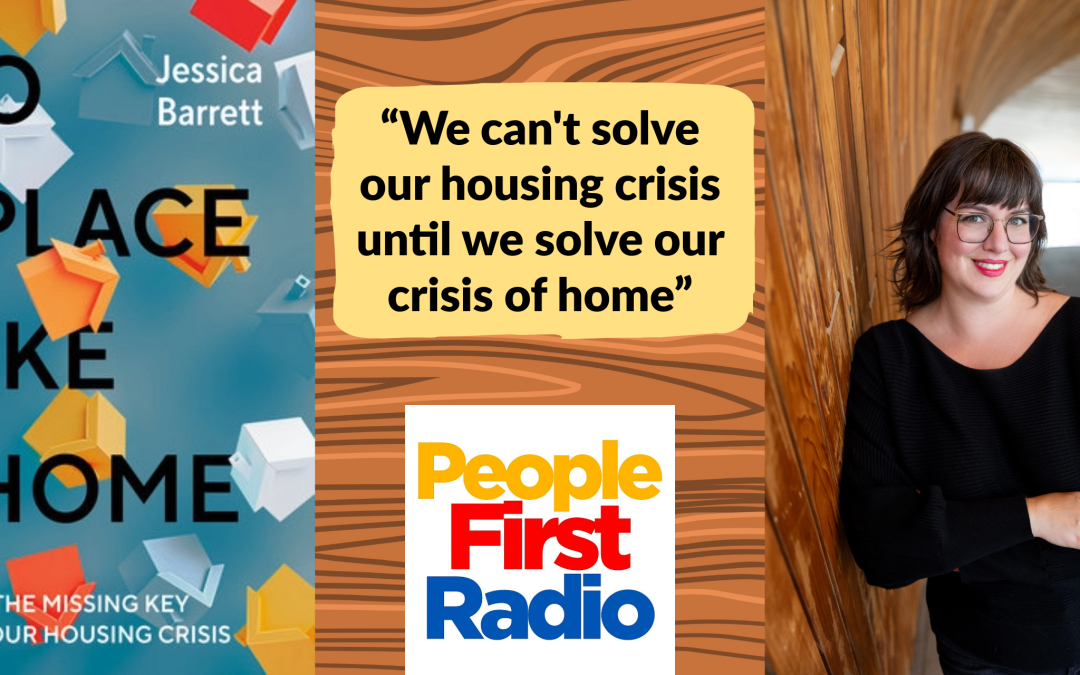


Journalist and author Jessica Barrett argues we can’t solve our housing crisis until we solve our crisis of home.
Barrett is the author of No Place Like Home: The Missing Key to Our Housing Crisis, which combines a macro view of the Canadian housing landscape with stories of individual people – including Barrett.
Over a decade ago she authored a viral column, wondering whether it was time to leave Vancouver.
Not long after that, she moved to Calgary, but displaced from her community, a sense of home was slower to materialize. Now in the process of moving back to Vancouver, Barrett spoke with People First Radio about the state of housing, and what she feels we could do differently.
“ We kinda have to reverse engineer this. Start with the feeling of home, and then figure out what type of housing facilitates that and contributes to that. Because right now, we’re not acknowledging that,” said Barrett.
“ I think we really need to look at introducing some emotional intelligence into the way that we produce housing, and the idea of home as a feeling, which is brought about by things like a sense of belonging, a sense of attachment to place and landscape and climate around you, a sense of familiarity, a sense of safety and security.”
Barrett argues that right now, housing in Canada is almost completely driven by the bottom line.
“Because we’ve relied so heavily on market-based housing for so long, for almost 100 years since the beginning of our housing policy, the one motivating factor that we have to get housing built in this country is profit,” she said.
“The problem with profit is…at the end of the day, it dictates what gets built, where it gets built, how many units are there, the shape of those units, and also discounts a lot of…the feelings about home.”
Barrett says the Canadian housing system is trying to do two contradictory things at the same time.
“ On the one hand, we want housing to be a profitable endeavor for developers, and we also want it to be a financial safety net for people who buy their homes and wanna use it for their retirement or whatever it is,” she said.
“On the other hand, we want people to be able to be housed and achieve the goal of homeownership or whatever it is, to be safe and secure in their housing. But the thing is you can’t have something be a continual financial investment that returns…and have it be accessible for people who don’t yet have that asset.”
Barrett says the consequence of this is that public money must continually be used to keep the system from collapsing.
“When housing has reached where it is now, where it is so expensive that so many people just simply cannot access housing on a regular income, you have to do things like come in and offer tax cuts and offer things like longer mortgages and more access to credit, and essentially allow people to take on more and more debt to keep the whole thing afloat.”
She argues more substantive investment in co-op housing would help ameliorate the situation. Barret says Canada was producing substantially more co-op housing circa 40-60 years ago.
“ I think it’s important to know that the solutions are out there, because we have had them before,” she said.
“ People still live in co-ops, and there are wait lists at every one in the country. That works, and we could be funding that instead of market housing, but we’re choosing not to.”
Barrett says a shift in Canadian housing policy is unlikely unless people demand it.
“I think one of the reasons that we’re not doing that is because we don’t necessarily know what’s possible,” she said. “This era of social housing in Canada has sort of been buried and sort of erased from people’s memories. Like, even sitting politicians don’t really know what co-op housing is or what social housing is or why it’s important, and we need to kind of bring that back to the forefront for people.”
 Apple Podcasts
 Spotify
 YouTube